Everything you need to evaluate how SiteStack controls jobsite procurement execution.

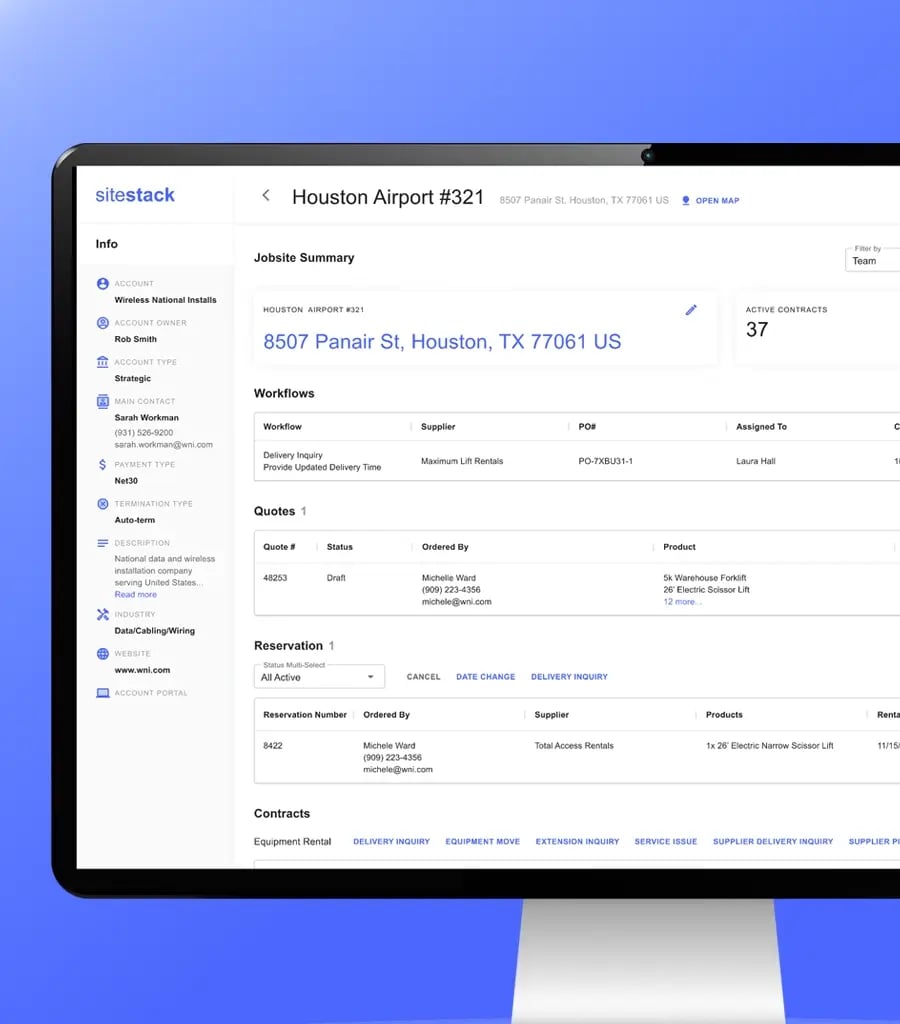
Construction procurement dashboard showing jobsite summary

How it Works

Structure your supplier base

Add your suppliers, BigRentz suppliers, or both. Configure locations, contacts, rate methods, hauling rules, service areas, preferences, and jobsite-specific requirements so every supplier decision starts with clean data.

Define the jobsite

Enter the location, dates, equipment, service requirements, constraints, and approval rules. SiteStack uses the jobsite as the decision point because location, timing, and site conditions change the real cost.

Rank suppliers by total cost

SiteStack evaluates supplier proximity, availability, hauling, pricing, performance, and jobsite requirements to identify the right supplier for that specific job — not just the lowest rate card.

Control execution through closeout

Route approvals, issue POs, track delivery, manage changes, confirm call-offs, resolve issues, and connect execution data to finance without running the process through emails, texts, and spreadsheets.

Why SiteStack Exists

Contractors do not lose money because they lack procurement. They lose money because procurement is not enforced at the jobsite.

For years, our largest customers asked the same question: “Can we use the tools your team uses internally to control supplier selection, jobsite logistics, rental lifecycle, and procurement cost?” 

The answer did not come immediately. The tipping point came from a Fortune 500 contractor spending more than $20 million per year across cranes, aerials, material handling, and site services.

They did not just need another procurement tool. They needed control over supplier selection, logistics, service requests, rental lifecycle, and vendor execution across jobsites.

On the surface, it made sense. But after analyzing their jobsite activity — equipment movements, haul distances, fuel zones, duration patterns, vendor performance, and regional availability — we found something more important:

They could save more than 20% — over $4 million annually — without renegotiating rates. The savings came from choosing the right supplier at the right jobsite, at the right moment, based on total cost.

And this was not a broken procurement team.

They had strong rate cards, standardized requisitions, and mature controls. The breakdown happened after procurement — in jobsite execution.

But the reality was universal:

  • Job sites change daily
  • Transportation drives cost variability
  • Regional vendor performance fluctuates
  • Supplier decisions shift in the field
  • Internal workflows break down across hundreds of people
  • Financial systems can’t match job-site data in real time

It became clear that no ERP module, project management system, procurement portal, asset tracker, marketplace, or spreadsheet could solve this alone. Each handled a piece. None controlled the execution layer.

So we built SiteStack — the platform that combines:

  • Jobsite intelligence
  • Supplier scoring and availability modeling
  • Geospatial analysis
  • Total-cost supplier selection 
  • Lifecycle and workflow orchestration
  • Financial reconciliation and AP dispute workflows

All designed to give contractors the same control layer that has powered our own operation for a decade — without needing a service provider in the middle.

Outcome:
A unified jobsite procurement execution platform that saves time, reduces leakage, and restores real cost control.


Compare SiteStack

SiteStack fits between the systems contractors already use.

Every contractor uses a mix of systems: ERPs, project management platforms, procurement tools, asset systems, supplier portals, spreadsheets, and internal processes.

Each solves part of the workflow. SiteStack controls the jobsite procurement execution layer between them: supplier selection, logistics, lifecycle, workflow, and financial handoff.

SiteStack does not replace your systems. It controls the decisions and workflows those systems do not own.

It becomes the operational control layer connecting jobsites, suppliers, workflows, and finance.

Below is how SiteStack compares to the systems most contractors rely on today.

PROCUREMENT & ERP SYSTEMS

SAP Ariba, Coupa, Oracle Fusion Procurement, Oracle NetSuite, Workday Procurement, QuickBooks, Sage Intacct

These systems excel at:

  • PO creation
  • financial governance
  • approvals
  • spend controls
  • vendor records

But they are not designed to:

  • select the best supplier for a specific jobsite
  • compute true total cost including hauling, fees, distance, and availability
  • manage rental lifecycle and call-off
  • orchestrate multi-vendor execution workflows
  • capture the field events behind invoice accuracy
  • unify jobsite procurement across regions

When ERPs are pushed into field execution, teams often fall back to spreadsheets.

SiteStack fills that gap — and integrates so finance stays aligned.

PROJECT MANAGEMENT SYSTEMS

Procore, Autodesk Construction Cloud, Trimble Viewpoint, Bluebeam, Fieldwire

These platforms centralize:

  • drawings
  • RFIs
  • scheduling
  • project documentation

But they do not control:

  • jobsite-specific supplier selection
  • true all-in cost including hauling and availability
  • rental lifecycle and call-off
  • multi-vendor dispatch workflows
  • supplier response history
  • field events tied to invoice accuracy

They document and coordinate the work.

SiteStack controls the procurement execution layer behind the work. 


MATERIAL PROCUREMENT & CATEGORY-SPECIFIC SYSTEMS

Kojo, Agora, Tradogram

These tools are strong for:

  • materials
  • packaged goods
  • standardized products
  • category-specific purchasing

But they are not built to fully control:

  • jobsite logistics
  • rental equipment lifecycle
  • hauling, delivery, pickup, and call-off
  • multi-vendor dispatch
  • cranes, lifts, dumpsters, specialty tools, and site services
  • multi-site execution programs

SiteStack completes the procurement picture for the vendor-driven work that touches a jobsite and requires real-world coordination. 

FIELD SERVICE & FACILITIES OPERATIONS TOOLS

ServiceNow, ServiceChannel, Jobber

These systems handle:

  • work orders
  • ticketing
  • routing
  • service workflows
  • asset management

But they are not designed to control:

  • rental procurement
  • supplier scoring
  • jobsite logistics
  • multi-supplier dispatch
  • daily equipment coordination
  • cost modeling by location
  • call-off, pickup, and invoice accuracy

High-volume rental and vendor-driven users inevitably hit blind spots.

SiteStack becomes the jobsite procurement control layer beneath these workflows — not a replacement.

And yes, we can integrate when needed.

THE BOTTOM LINE

Every system above solves a portion of the workflow.

SiteStack controls the logistics-heavy, vendor-heavy, jobsite execution layer of procurement.

SiteStack unifies:

  • suppliers
  • jobsite data
  • workflows
  • dispatch
  • lifecycle tracking
  • cost modeling
  • financial alignment

It gives contractors the same level of control, visibility, and intelligence used to manage more than $1B in rental procurement — without needing a service provider in the middle.

This is SiteStack’s category: jobsite procurement execution control.

Detailed use cases and case studies.

See how SiteStack helps contractors control supplier selection, logistics, rental lifecycle, workflows, and cost accuracy across different types of work.

FAQs

What contractors need to know before evaluating SiteStack


What is SiteStack?

SiteStack is a construction procurement control platform that determines the right supplier for each jobsite based on total cost, distance, availability, and execution requirements — then controls what happens from request through delivery, pickup, call-off, and invoice.

Who is SiteStack built for?

SiteStack is built for contractors and service organizations managing recurring, multi-site, or complex jobsite work where supplier selection, rentals, hauling, delivery, pickup, call-off, and invoice accuracy affect cost. It supports operations leaders, procurement teams, project managers, field teams, and finance groups that need consistent control across suppliers and jobsites.

What problem does SiteStack solve?

Contractors lose money when jobsite procurement decisions happen outside the systems that are supposed to control cost. Supplier selection, hauling, availability, delivery, pickup, call-off, and invoice accuracy are often managed through emails, texts, portals, spreadsheets, and individual knowledge. 

SiteStack replaces that fragmented execution with controlled workflows, total-cost supplier selection, lifecycle visibility, and financial handoff. 

What can I do with SiteStack?

With SiteStack, you can:

  • Centralize rental, supplier, equipment, service, and vendor requests
  • Select suppliers based on jobsite-specific total cost, distance, availability, hauling, and performance
  • Track deliveries, pickups, call-offs, and jobsite status
  • Standardize approvals, workflows, documentation, and supplier communications
  • Connect requests, POs, deliveries, lifecycle events, and invoices
  • Report spend, supplier performance, exceptions, and cost leakage by project, program, region, or vendor


How is SiteStack different from spreadsheets or internal tools?

Spreadsheets and internal tools can track activity, but they cannot enforce supplier decisions, normalize hauling rules, manage rental lifecycle, trigger call-offs, control multi-vendor workflows, or create audit-grade execution data. 

SiteStack replaces manual, reactive tracking with controlled jobsite procurement execution built for scale.

How is SiteStack different from a rental marketplace?

Marketplaces help you find or place an order. SiteStack controls the decision and execution process across your suppliers, BigRentz suppliers, or both. It is not a marketplace. It is a control platform for jobsite procurement execution.

FAQs

Fit & Scope


Does SiteStack replace my rental vendors?

No. SiteStack does not replace your vendors. It standardizes and controls how you work with them. You keep your preferred suppliers while gaining one process for requests, supplier responses, pricing, hauling, delivery, pickup, call-off, and billing.

Can SiteStack work with our existing vendors and internal processes?

 Yes. SiteStack is designed to layer onto your current vendors, rate cards, approval paths, finance processes, and jobsite workflows without forcing you to change who you buy from. You can keep the relationships you rely on while bringing supplier decisions, workflows, and lifecycle events into one controlled process.

Is SiteStack only for equipment rentals?

No. SiteStack is strongest where equipment rental, hauling, delivery, pickup, and call-off create cost leakage, but the same workflow model can support dumpsters, cranes, site services, materials, labor, and other vendor-driven jobsite procurement.

Can SiteStack handle multi-site or nationwide projects?

Yes. SiteStack is built for recurring, multi-site, regional, and nationwide work. It standardizes supplier selection, pricing, hauling logic, approvals, delivery, pickup, call-off, and reporting across jobsites while still accounting for local supplier availability and jobsite conditions.

Will it integrate with our finance systems?

Yes. SiteStack is built to integrate with accounting and ERP systems. The goal is to send finance cleaner execution data — approved POs, delivery events, lifecycle changes, call-offs, and invoice details — so financial workflows stay aligned with what happened in the field.

Is SiteStack difficult to use?

No. SiteStack is built for field teams and operators, with a clean, intuitive interface that mirrors real-world workflows. Most teams can enter their suppliers, configure basic settings, and be up and running in an afternoon.

Is training required?

Yes—though it’s lightweight. SiteStack includes onboarding support, training videos, and a dedicated rep to help your operations, procurement, and finance teams get fully comfortable and productive quickly.

FAQs

Economics & Operations


How does SiteStack reduce costs?

SiteStack reduces costs by:
  • Selecting suppliers by jobsite-specific total cost
  • Reducing hauling and logistics leakage
  • Identifying idle or forgotten equipment
  • Preventing duplicate or overlapping rentals
  • Standardizing approvals, supplier rules, and workflows
  • Improving forecasting and site-level planning
  • Reducing maverick spend across regions
  • Aligning requests, POs, deliveries, call-offs, and invoices 
Most savings come from controlling the decisions and lifecycle events that create cost before finance sees the invoice.

How is SiteStack priced?

SiteStack is priced based on annual procurement volume and program complexity. Larger programs receive progressively lower rates, and multi-year agreements can include additional savings. The model is designed to align pricing with procurement volume and value delivered, not seat count.

Can SiteStack help with budgeting and forecasting?

Yes. SiteStack centralizes supplier pricing, jobsite activity, rental lifecycle data, and actual cost events so finance and operations can compare projected spend, actuals, trends, and variance across projects. That data can support estimating, forecasting, and project-level P&L planning. 

How long does implementation take?

Implementation depends on supplier volume, workflow complexity, and integrations, but most teams can be operational within a few weeks. Customers can start with supplier setup and core workflows first, then phase in integrations and more advanced controls over time.

Is our data secure?

Yes. SiteStack uses enterprise-grade security practices, including authentication, role-based access, activity logging, environment controls, and auditable workflows. The platform is designed to protect procurement, supplier, jobsite, and financial data across multi-user and multi-vendor environments.

Who owns the data?

You do. Your organization retains full ownership of all procurement, rental, and operational data in the platform, and it can be exported at any time.

FAQs

Final Evaluation


How do I know if SiteStack is right for us?

SiteStack is a strong fit if you manage recurring, multi-site, regional, or complex work and spend materially on equipment rentals, hauling, site services, or vendor-driven jobsite procurement. It is especially valuable when supplier selection varies by jobsite, equipment stays on rent too long, finance lacks clean execution data, or billing reconciliation takes too much time.

Can I see a demo?

Yes. You can request a walkthrough focused on your supplier structure, jobsite workflows, rental lifecycle, integration needs, and cost-control priorities.

Security & Governance

Enterprise-grade security built for contractors, field operations, and multi-vendor ecosystems.

SiteStack manages procurement workflows, supplier activity, jobsite data, rental lifecycle events, and financial handoff — and we treat that responsibility with a strong security and governance posture. The platform is built for contractors running dozens to thousands of simultaneous projects across teams, vendors, and jobsites.

Identity & Access Control

  • Role-based access control (RBAC)
  • Organization-level and project-level permissions
  • Multi-tenant isolation
  • Ory-based identity management
  • SSO / SAML 2.0

Data Security

  • Encryption in transit and at rest
  • Encrypted secrets and credential storage
  • Tiered access for vendors, subs, and internal teams
  • Strict segregation of customer environments

Operational Governance

  • Audit trails for every transaction and lifecycle event
  • Automated approval workflows
  • Full visibility into changes, bookings, returns, and disputes
  • Governance layer across suppliers, dispatching, and AP

Application & API Security

  • Hardened API gateway
  • Signed webhook payloads
  • Least-privilege access patterns
  • Continuous vulnerability scanning

Compliance

  • SOC 2–aligned controls
  • Data retention and deletion policies
  • Incident response and monitoring
  • Regular third-party testing

FAQs

Final Evaluation


What is SiteStack?

SiteStack is a procurement and equipment rental management platform designed specifically for contractors managing multi-site and large-scale projects. It centralizes rental ordering, tracking, reporting, and vendor coordination into one streamlined system.

Who is SiteStack built for?

Sitestack is built for:

  • Operations leaders managing multiple job sites
  • Procurement teams overseeing rental spend
  • Project managers responsible for site-level execution
  • Finance teams tracking equipment budgets and cost controls

It’s especially valuable for organizations running distributed projects across regions.

What problem does SiteStack solve?

Most contractors don’t realize how fragmented their rental procurement is until costs start stacking up. Sitestack solves:

  • Vendor fragmentation
  • Inconsistent pricing
  • Lack of real-time visibility
  • Manual tracking across spreadsheets
  • Idle equipment waste
  • Billing reconciliation issues

It replaces chaos with visibility and control.

What can I do with SiteStack?

With Sitestack, you can:

  • Centralize all equipment rental requests
  • Track equipment by site in real time
  • Monitor utilization and idle time
  • Standardize pricing and approvals
  • Generate spend reports by project, region, or vendor
  • Simplify billing reconciliation

How is SiteStack different from spreadsheets or internal tools?

Spreadsheets don’t scale across regions, teams, and vendors. Sitestack provides:

  • Real-time visibility
  • Automated tracking
  • Standardized workflows
  • Centralized reporting
  • Audit trails

It replaces reactive reporting with proactive control.

How is SiteStack different from a rental marketplace?

Marketplaces help you transact. SiteStack helps you manage, control, and optimize procurement at scale.

Does SiteStack replace my rental vendors?

No. SiteStack does not replace your vendors — it streamlines how you work with them. You can continue using your preferred suppliers while gaining centralized control and visibility.