
Why Equipment Rental Invoices Are So Hard to Validate
Construction companies spend significant time trying to reduce equipment rental costs.
One of the most common strategies is sourcing equipment from the supplier closest to the jobsite.
On the surface, this makes sense. A nearby supplier should reduce hauling costs, shorten delivery times, and improve responsiveness throughout the rental lifecycle.
In reality, supplier proximity is only one variable in a much larger procurement decision.
The challenge is that equipment rental costs are influenced by pricing, logistics, availability, service coverage, delivery zones, and supplier performance. As a result, the closest supplier is often not the supplier that creates the lowest total cost for the project.
This is one of the reasons construction equipment procurement is fundamentally different from standard procurement.
Distance Does Not Equal All-in Cost
One of the biggest misconceptions in equipment rental procurement is the assumption that shorter distance automatically produces lower cost.
It does not.
While location impacts transportation expenses, it does not determine:
- Equipment availability
- Delivery capacity
- Pickup responsiveness
- Rental rates
- Service support
- Supplier performance
- Branch coverage
- Delivery zone pricing
Two suppliers serving the same project may be separated by only a few miles, yet create dramatically different financial outcomes.
The procurement decision requires understanding much more than geography.
Supplier Selection Is a Total Cost Problem
When contractors evaluate suppliers, the conversation often begins with location.
The more important question is: What is the total cost of fulfilling this rental?
That calculation includes:
- Rental rates
- Delivery fees
- Pickup fees
- Hauling costs
- Fuel surcharges
- Mobilization charges
- Downtime risk
- Availability constraints
- Service responsiveness
Construction procurement teams increasingly recognize that supplier selection is not a distance problem.
It is a total cost problem.
This is where concepts like supplier total cost comparison become increasingly important.
Availability Often Overrides Proximity
A supplier can be located five miles from a project and still be unable to fulfill a request.
Construction schedules are driven by equipment availability, not branch addresses.
Procurement teams routinely encounter situations where:
- The nearest supplier has no inventory available
- The closest branch cannot deliver within the required timeframe
- Equipment must be sourced from another yard
- A secondary supplier can fulfill the request faster
In these situations, availability becomes more important than proximity.
The closest supplier only creates value if the equipment can actually be delivered when needed.
Hauling Costs Are More Complex Than Mileage
Many organizations evaluate hauling costs using simple distance assumptions.
The reality is significantly more complicated.
Hauling expenses are influenced by:
- Equipment type
- Delivery method
- Branch location
- Route complexity
- Delivery timing
- Transportation availability
- Supplier logistics networks
A supplier located farther from the project may operate a more efficient transportation network and ultimately deliver equipment at a lower cost.
Likewise, a nearby supplier may impose delivery minimums, premium transportation fees, or zone-based charges that increase overall spend.
This is why hauling cost optimization requires visibility into transportation economics rather than simply measuring distance.
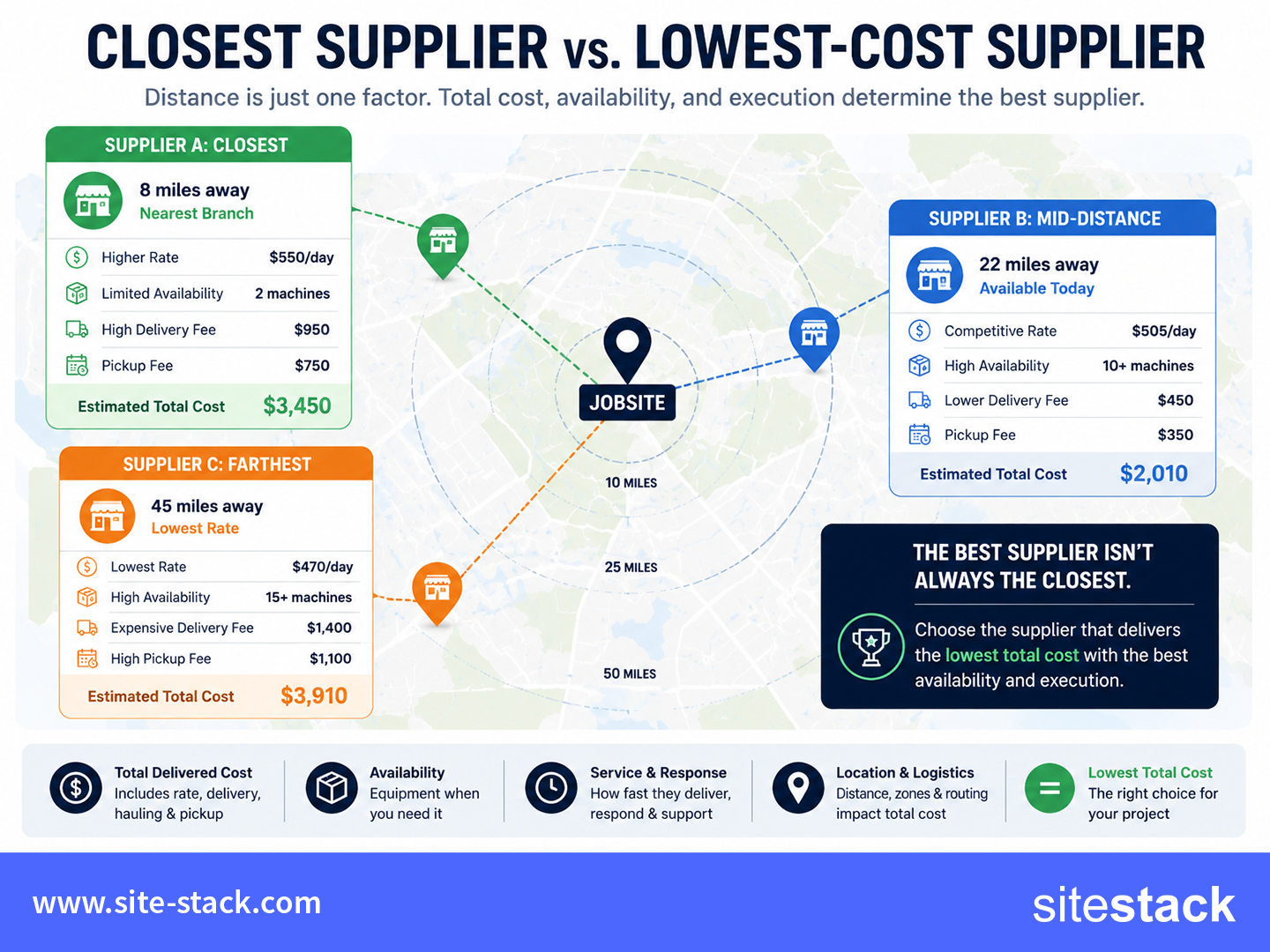
Construction suppliers rarely operate using simple radius-based coverage models.
Most suppliers manage:
- Branch territories
- Delivery zones
- Service regions
- Dispatch networks
- Transportation schedules
As a result, two suppliers located similar distances from a project may produce very different transportation costs.
The map may suggest one answer.
The logistics network may produce another.
Organizations that rely solely on location frequently overlook these operational realities.
Why Procurement Intelligence Matters
Historically, supplier selection relied heavily on relationships, experience, and local knowledge.
While those factors remain important, large contractors increasingly require a more data-driven approach.
They need visibility into:
- Supplier proximity
- Equipment availability
- Transportation costs
- Rental rates
- Historical performance
- Service responsiveness
This is where construction procurement intelligence becomes valuable.
The goal is not simply identifying the closest supplier.
The goal is identifying the supplier that creates the best operational and financial outcome.
Why SiteStack Was Built Differently
SiteStack approaches equipment procurement as a location-driven decision, but not a location-only decision.
The platform helps contractors evaluate:
- Supplier proximity
- Availability
- Hauling costs
- Delivery zones
- Supplier performance
- Rental execution
By combining these variables, contractors gain a more complete understanding of which supplier is truly best positioned to support the project.
Because in construction equipment procurement, the closest supplier is not always the lowest-cost supplier.
And the lowest-cost supplier is not always the best supplier.
The best supplier is the one that delivers the strongest overall outcome for the project.