
Why Contractors Need a System of Record for What Is On Rent
Equipment rental invoices are some of the most difficult invoices for construction accounting teams to validate accurately.
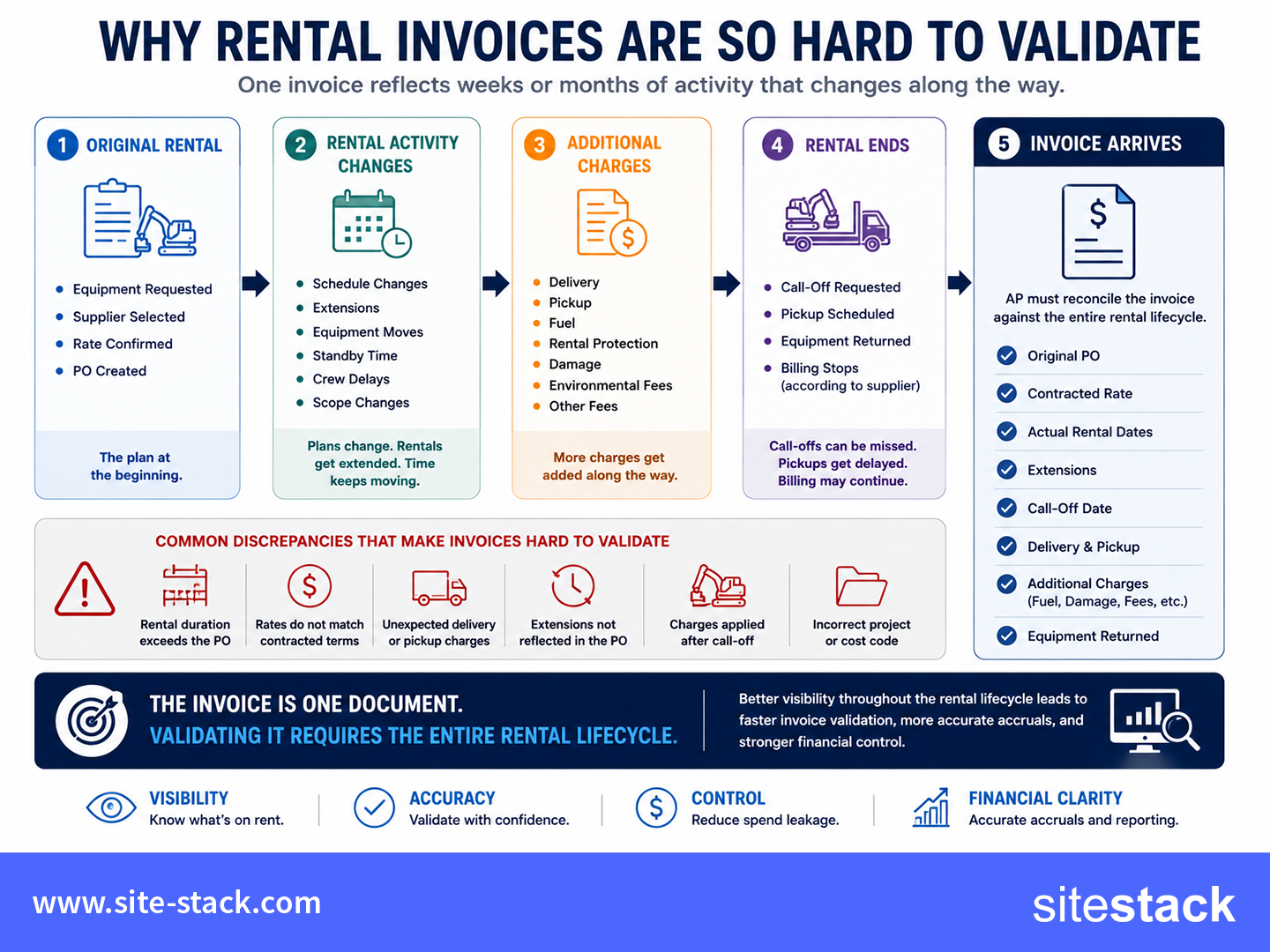
The challenge is not simply invoice complexity. A rental invoice reflects weeks or months of operational activity that may have changed significantly since the original purchase order was created. Rental periods get extended, equipment moves, call-offs are missed, delivery and pickup charges are added, and project schedules change.
By the time the invoice reaches accounts payable, the information required to validate it may be spread across procurement records, supplier systems, jobsite teams, emails, purchase orders, and rental agreements.
This is why rental invoice validation is fundamentally different from matching an invoice for a standard purchase.
A Rental Purchase Order Is Only the Starting Point
Traditional invoice validation typically compares three pieces of information: what was ordered, what was received, and what was invoiced.
Equipment rentals do not remain that static.
A purchase order may have been created for a four-week rental, but the equipment could remain on site for six weeks. A project team may request an extension without updating the original PO. Equipment may be called off but remain on rent while waiting for pickup. Additional transportation, fuel, protection, or damage charges may appear later.
As a result, accounts payable cannot simply ask whether the invoice matches the original purchase order.
The team must determine whether the invoice matches what actually happened.
Rental Duration Creates Constant Variability
Time is one of the biggest reasons rental invoices are difficult to validate.
Construction schedules change constantly. Work gets delayed, project phases shift, equipment remains needed longer than expected, and rentals that were originally planned for days can remain active for weeks or months.
This creates questions that accounting teams must eventually reconcile:
- When did the rental actually begin?
- What rental period was originally authorized?
- Was the rental extended?
- Who approved the extension?
- When did the project stop using the equipment?
- When was the equipment called off?
- When did the supplier actually stop billing?
A small difference between these dates can create a significant difference in cost, particularly across large equipment fleets and long-duration projects.
Missed Call-Offs Become Accounting Problems
A missed call-off begins as an operational issue but eventually becomes a financial one.
Equipment may no longer be needed on the jobsite, but if the supplier has not been notified, the rental can continue accruing charges. In other situations, the call-off may have occurred but the equipment remains on site waiting for pickup, creating uncertainty around when billing should stop.
By the time AP sees the charge, determining what happened may require conversations with the project team, procurement, operations, and the supplier.
This is why equipment call-off tracking is closely connected to invoice accuracy. Better visibility earlier in the rental lifecycle reduces the amount of investigation required after the invoice arrives.
The Base Rental Rate Is Only One Charge
Even when the rental duration is correct, the equipment rate represents only part of the invoice.
Rental invoices can include charges related to:
- Delivery
- Pickup
- Fuel
- Environmental fees
- Rental protection
- Damage
- Cleaning
- Overtime
- Mobilization
- Other supplier-specific fees
Some charges may be expected. Others may require additional validation against supplier agreements, project records, or operational activity.
This creates another layer of complexity for accounts payable. A correct base rental rate does not necessarily mean the final invoice is correct.
Effective rental invoice reconciliation requires understanding both the contracted commercial terms and what actually occurred in the field.
Purchase Orders and Rental Activity Drift Apart
Purchase orders are typically created at a specific point in time.
Rentals continue changing after that point.
This creates what can effectively become PO drift, where the original procurement record and the current rental reality no longer align. The equipment may remain on rent beyond the authorized period, additional charges may accumulate, or the final cost may exceed the original purchase order.
Common discrepancies include:
- Rental duration exceeding the PO
- Rates that do not match contracted terms
- Unexpected delivery or pickup charges
- Extensions that were never reflected in the PO
- Equipment changes or substitutions
- Charges applied after a call-off
- Incorrect project or cost-code information
When these differences are discovered at the invoice stage, AP becomes responsible for reconstructing decisions that may have happened weeks or months earlier.
The problem is not simply purchase order compliance.
It is the lack of a continuously updated connection between procurement activity and rental activity.
Accruals Depend on Knowing What Is Actually On Rent
Rental invoice complexity also creates challenges before the invoice arrives.
Finance teams need to understand current liabilities even when suppliers have not yet submitted invoices. To calculate accurate equipment rental accruals, organizations need reliable information about what is currently on rent, how long it has been active, what rates apply, and which additional costs may be accumulating.
If rental status is incomplete or outdated, accrual estimates become less reliable.
This creates financial uncertainty around questions such as:
- Which rentals are still active?
- What costs have accumulated since the last invoice?
- Which rentals have been extended?
- What projects have unbilled rental exposure?
- Which equipment should already have been returned?
Accurate financial reporting therefore depends on accurate operational visibility.
AP Cannot Validate What the Organization Did Not Track
Many rental invoice problems appear to be accounting problems because accounting is where the discrepancy is eventually discovered.
In reality, the underlying issue often occurred much earlier in the rental lifecycle.
If an extension was not recorded, AP cannot easily validate it.
If a call-off was not tracked, AP may not know when billing should have stopped.
If delivery or pickup activity is unavailable, transportation charges become difficult to confirm.
If rental status is fragmented across supplier portals, spreadsheets, and jobsite records, accounting teams are forced to reconstruct the transaction after the fact.
The invoice exposes the problem.
It usually does not create it.
Rental Invoice Validation Requires Operational Data
Improving rental invoice accuracy requires connecting financial controls with operational rental activity.
Accounting teams need access to more than an invoice and a purchase order. They need visibility into:
- Original rental requests
- Contracted rates
- Equipment delivery
- Rental start dates
- Extensions
- Current rental status
- Call-off activity
- Pickup dates
- Additional fees
- Final rental duration
When this information is connected, rental invoice validation becomes less dependent on emails, phone calls, spreadsheets, and individual project knowledge.
Instead of reconstructing the rental lifecycle after an invoice arrives, contractors can maintain the information throughout the rental.
Why SiteStack Connects Rental Activity With Financial Visibility
SiteStack was built around the reality that equipment rental costs cannot be managed effectively if procurement, operations, and accounting are working from different information.
By connecting rental activity, supplier information, purchase orders, rates, extensions, call-offs, and financial exposure, contractors can create a clearer record of what happened throughout the rental lifecycle. This gives AP better information for invoice validation while giving finance greater visibility into accruals and current rental liabilities.
The objective is not simply to process rental invoices faster.
It is to make rental invoices easier to validate because the underlying operational data already exists.
Because by the time an invoice arrives, the contractor should not be trying to figure out what happened.
They should already know.