
Why Equipment Rental Invoices Are So Hard to Validate
Construction companies have more access to supplier information than ever before. Major rental providers offer sophisticated customer portals where contractors can view equipment, manage rentals, access invoices, review rates, and track activity across projects.
These portals provide real value. They make it easier for contractors to work with individual suppliers and give project teams greater visibility into transactions that previously required phone calls, emails, and spreadsheets.
The challenge begins when a contractor works with more than one supplier.
Most large construction organizations rely on regional rental companies, national providers, specialty vendors, and local suppliers across hundreds of jobsites. Each supplier may provide excellent visibility into its own activity, but no supplier can provide visibility into the contractor’s entire rental operation.
The result is not a lack of supplier data. It is fragmentation across supplier data.
Supplier Portals Are Designed Around the Supplier
Supplier portals are designed to answer questions about the equipment and transactions managed by that supplier.
Depending on the provider, contractors may be able to view:
- Active rentals
- Equipment locations
- Rental rates
- Contracts
- Invoices
- Delivery information
- Pickup requests
- Account activity
These capabilities are valuable because they improve communication and transaction visibility between the contractor and supplier.
However, the portal only knows what exists within that supplier’s network.
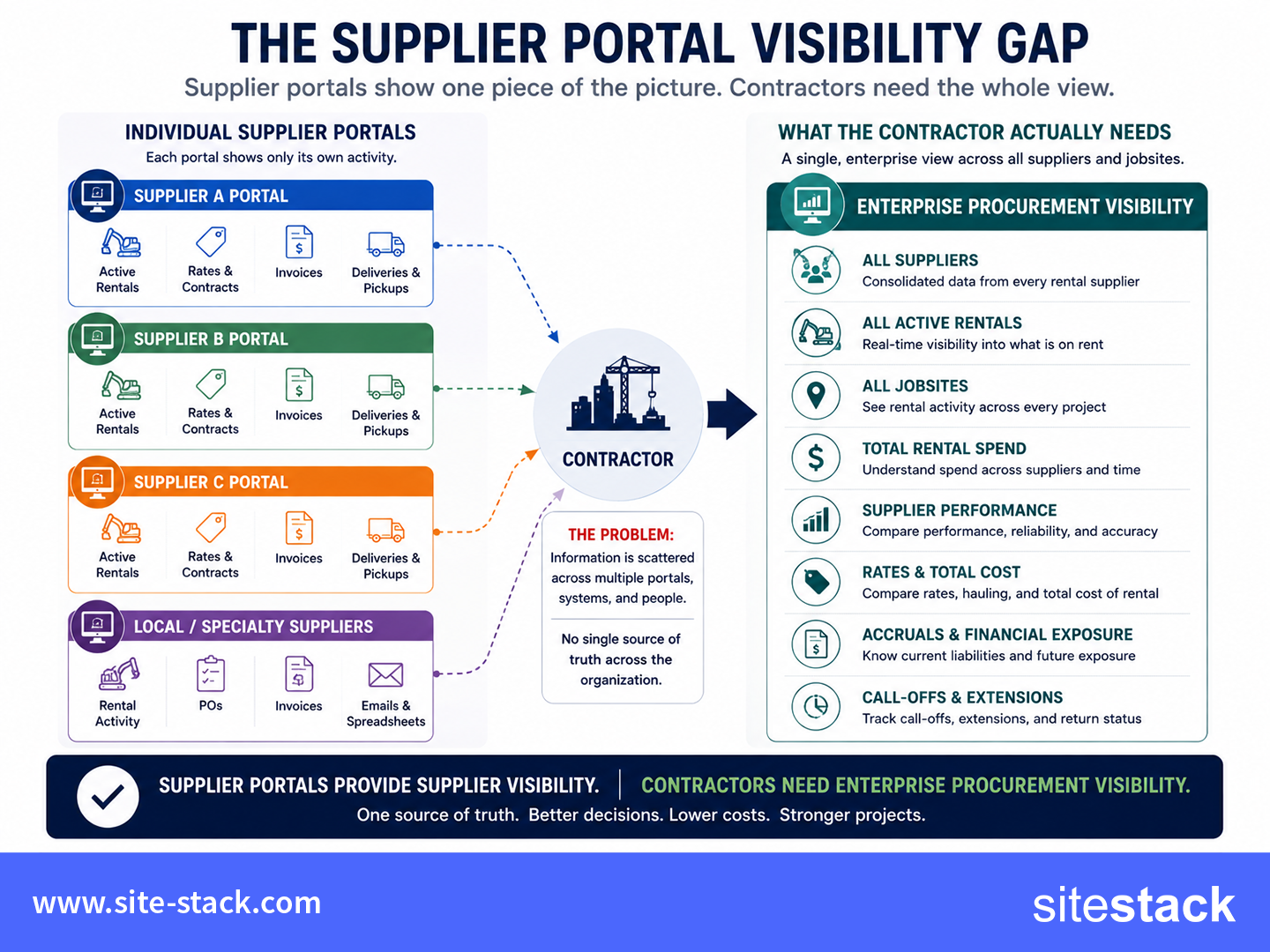
If a contractor uses five rental suppliers, each portal represents one part of the contractor’s equipment environment. Procurement teams must move between systems to understand what is happening across the organization.
The supplier has a complete view of its relationship with the contractor.
The contractor still does not have a complete view of its relationships with every supplier.
Construction Procurement Is a Multi-Supplier Problem
Construction equipment procurement is rarely centralized around a single provider.
Equipment availability changes by market. Specialty categories require different vendors. Local suppliers may outperform national providers in certain regions. Existing relationships vary by operating company, and project teams often need flexibility when equipment is required quickly.
As a result, enterprise contractors frequently manage:
- Multiple national rental suppliers
- Regional rental companies
- Specialty equipment providers
- Local suppliers
- Different supplier agreements by business unit
- Different supplier relationships by geography
This creates a fundamentally different visibility problem.
The question is no longer, "What do we have on rent with this supplier?"
The question becomes, "What do we have on rent across every supplier?"
That distinction is critical to effective construction procurement visibility.
Portal Fragmentation Creates Multiple Versions of Rental Activity
When rental activity is distributed across multiple supplier portals, each platform becomes its own source of information.
One supplier may show 40 active rentals.
Another may show 25.
A regional provider may show another 10.
Additional rental activity may exist in purchase orders, spreadsheets, emails, or local project records.
Each source can be accurate individually while the organization still lacks an accurate enterprise view.
This makes seemingly straightforward questions difficult to answer:
- What equipment is currently on rent across the company?
- How much are we spending across all rental suppliers?
- Are multiple projects renting similar equipment?
- Which suppliers are receiving the most volume?
- Are contracted rates being followed consistently?
- Where are supplier performance issues occurring?
- What rental liabilities are currently accruing?
No individual supplier portal can answer these questions because no individual supplier has access to the entire rental environment.
Comparing Suppliers Requires Data Outside the Portal
Supplier portals are also limited when contractors need to compare procurement options.
A supplier can show its own rates, equipment availability, branch locations, and rental activity. What it cannot objectively determine is whether another supplier represents a better option for the project.
Effective construction supplier management requires contractors to compare suppliers across common criteria, including:
- Negotiated rates
- Equipment availability
- Jobsite proximity
- Delivery and hauling costs
- Supplier performance
- Response times
- Invoice accuracy
- Total rental cost
This comparison becomes especially important in equipment procurement because the lowest rental rate does not necessarily produce the lowest total cost.
A portal can help a contractor transact with a supplier.
It cannot provide a neutral view across the entire supplier ecosystem.
Equipment Visibility Needs to Extend Across Suppliers
The same limitation applies after equipment has been delivered.
A contractor may have excellent visibility into rentals from one major provider while having limited visibility into equipment sourced from regional or specialty suppliers. Operations teams then have to combine multiple data sources to understand what is actually on rent across a project or business unit.
Without consolidated equipment rental visibility, contractors can struggle to identify:
- Duplicate rentals
- Idle equipment
- Missed call-offs
- Unnecessary extensions
- Equipment awaiting pickup
- Rental activity across multiple jobsites
These are contractor-level problems rather than supplier-level problems.
Solving them requires a view that sits above individual supplier relationships.
More Portals Do Not Create a System of Record
Adding another supplier portal gives the organization more information.
It does not necessarily create more organizational visibility.
As contractors scale, the problem can actually become more difficult. Every new supplier, operating company, region, and project introduces another potential source of procurement data that must be reconciled with the rest of the business.
A true system of record needs to normalize activity across suppliers rather than require teams to reconstruct the enterprise picture manually.
That means bringing together information such as:
- Rental activity
- Supplier data
- Rates
- Equipment status
- Purchase orders
- Invoices
- Jobsite information
- Financial exposure
The objective is not to replace supplier portals. Those systems remain useful for managing individual supplier relationships.
The objective is to create a procurement layer that connects them.
Why SiteStack Was Built Across the Supplier Ecosystem
SiteStack was designed around the reality that construction companies operate across fragmented supplier networks.
Rather than replacing supplier relationships or the portals that support them, SiteStack provides contractors with a common view across suppliers, jobsites, rental activity, and procurement data. This allows organizations to evaluate supplier performance, understand what is on rent, compare procurement options, monitor financial exposure, and make decisions using the entire rental environment rather than one supplier at a time.
Supplier portals solve an important problem: they make it easier to work with an individual supplier.
Construction procurement requires a broader view, Because the contractor does not manage one supplier’s rental operation.
It manages all of them.