
Why Equipment Rental Invoices Are So Hard to Validate
Construction companies spend enormous amounts of time negotiating rental rates.
Supplier agreements are reviewed. Discounts are negotiated. Rate cards are compared. Procurement teams work hard to ensure projects receive the best possible pricing.
The assumption is straightforward:
If Supplier A offers a lower rate than Supplier B, Supplier A should be the lower-cost option.
Unfortunately, equipment rentals do not work that way.
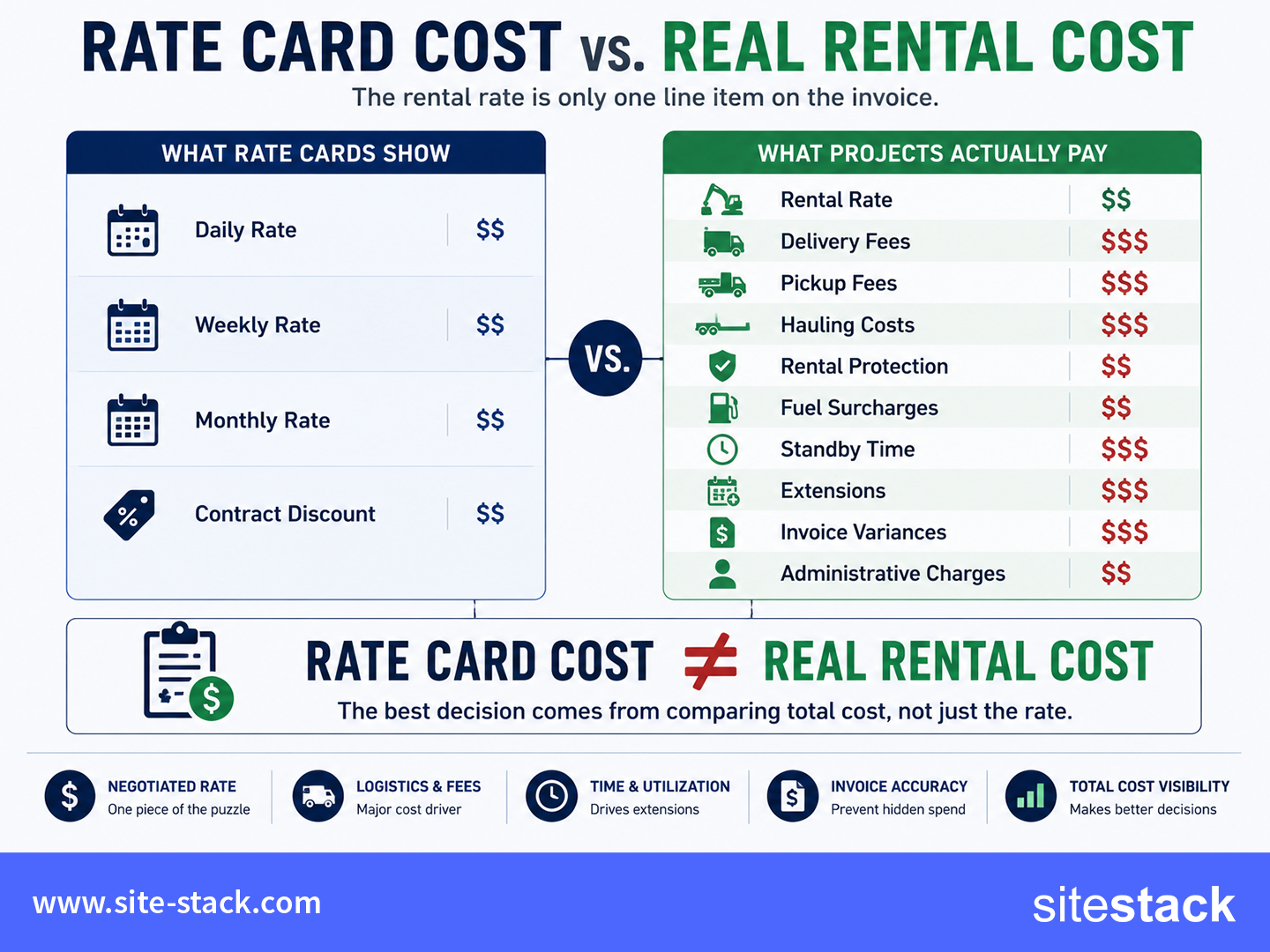
One of the biggest misconceptions in construction equipment procurement is the belief that rate cards accurately represent the true cost of a rental. While rental rates are important, they are only one component of a much larger financial picture.
The reality is that equipment costs are influenced by logistics, hauling, delivery fees, rental duration, utilization, extensions, standby time, protection plans, and invoice accuracy. As a result, the supplier with the best rate card is often not the supplier creating the lowest total cost.
This is why comparing suppliers based solely on rental rates frequently produces misleading conclusions.
Rate Cards Only Show Part of the Equation
A rate card is designed to communicate equipment pricing. It is not designed to communicate total rental cost.
When contractors compare suppliers using only negotiated rates, they often overlook expenses that occur throughout the rental lifecycle.
These costs may include:
- Delivery fees
- Pickup fees
- Hauling charges
- Fuel surcharges
- Rental protection programs
- Environmental fees
- Damage waivers
- Standby time
- Overtime charges
- Rental extensions
- Administrative fees
None of these costs are typically visible during a simple rate card comparison.
Yet they often determine the final cost of the rental.
This is why equipment procurement is fundamentally different from purchasing many other goods and services.
The Lowest Rate Does Not Always Produce the Lowest Cost
Construction procurement teams often encounter situations where one supplier appears cheaper on paper but becomes more expensive in practice.
A supplier may offer:
- Lower rental rates
- Higher hauling fees
- Longer delivery lead times
- Higher pickup costs
- Limited availability
- More frequent rental extensions
Another supplier may offer:
- Slightly higher rates
- Lower logistics costs
- Faster delivery
- Better equipment availability
- More efficient pickup execution
The first supplier wins the rate card comparison.
The second supplier may win the total cost comparison.
The challenge is that many procurement decisions are still made using incomplete information.
Freight and Logistics Often Outweigh Rate Differences
One of the most overlooked variables in supplier selection is transportation cost.
Many contractors focus on rate differences measured in dollars per day while overlooking freight expenses measured in hundreds or thousands of dollars per move.
Equipment must be:
- Delivered
- Picked up
- Relocated
- Exchanged
- Serviced
Every movement creates cost.
For larger equipment categories, hauling expenses can easily exceed the savings created by a lower negotiated rate. This is particularly true when projects are spread across multiple jobsites or suppliers operate from different branch locations.
This is why effective equipment rental cost optimization requires visibility into logistics, not just pricing.
Most rental overruns do not originate from rate cards.
They originate from time.
Equipment that remains on rent longer than expected often becomes one of the largest contributors to rental spend.
Common causes include:
- Schedule changes
- Delayed pickups
- Missed call-offs
- Idle equipment
- Project delays
- Poor visibility into on-rent assets
A contractor may negotiate an excellent rental rate and still overspend significantly if equipment remains on rent beyond its productive use.
The procurement decision may have been correct.
The rental execution was not.
This distinction is increasingly important as contractors seek greater control over rental spend.
Invoice Drift Is a Growing Challenge
Many contractors discover the true cost of a rental only after the invoice arrives.
By that point, the equipment has already been delivered, utilized, extended, and off-rented.
Invoice reviews frequently uncover:
- Unexpected fees
- Extension charges
- Transportation discrepancies
- Protection plan costs
- Incorrect rental durations
- Contract compliance issues
Over hundreds or thousands of rentals, these small variances accumulate into substantial spend.
This is why rental invoice reconciliation has become a growing focus for procurement and finance teams.
The objective is no longer simply securing negotiated rates.
The objective is ensuring the final invoice reflects the expected cost.
Why Total Cost Visibility Matters
Historically, supplier comparisons focused on rates because rates were easy to measure.
Today, contractors require a broader view.
They need visibility into:
- Rental rates
- Freight costs
- Equipment availability
- Supplier performance
- Rental duration
- Extension activity
- Invoice accuracy
- Total delivered cost
This is where construction procurement intelligence becomes increasingly valuable.
The goal is not simply identifying the supplier with the cheapest rate card.
The goal is identifying the supplier that creates the lowest overall cost while supporting project execution.
Why SiteStack Was Built Around Total Cost
SiteStack approaches equipment procurement through the lens of total cost rather than rate card comparisons alone.
The platform helps contractors evaluate the variables that ultimately drive rental spend, including logistics, hauling, utilization, supplier performance, rental lifecycle activity, and invoice validation.
Because construction companies do not pay rate cards.
They pay invoices.
And the difference between those two numbers is often where the biggest opportunities for savings exist.