
Why Equipment Rental Invoices Are So Hard to Validate
One of the most common assumptions in construction procurement is that lower rental rates automatically lead to lower equipment costs.
That assumption is often wrong.
Most contractors spend significant time negotiating master agreements, discounted rate cards, and preferred supplier relationships. While those efforts are important, they can also create a false sense of cost control. The negotiated rate is only one component of the total cost of a rental, and in many cases it is not the component driving the biggest financial outcome.
A supplier can offer the lowest daily rate and still end up being the most expensive rental provider on the project.
The reason is simple: equipment costs are influenced by much more than the number listed on a rate card.
The Problem with Rate-Card Thinking
When procurement teams evaluate rental costs, the conversation often begins and ends with pricing. Which supplier offered the lowest rate? Which contract provides the biggest discount? Which vendor gave us the best percentage off list price?
Those questions matter, but they rarely tell the full story.
Construction equipment is different from most purchased goods because it is tied to location, logistics, utilization, and time. Once a piece of equipment is rented, a new set of cost drivers begins to emerge. Delivery charges, hauling fees, rental duration, equipment availability, idle time, extensions, and supplier responsiveness all influence what the rental actually costs the project.
A lower rate does not eliminate those variables. In some cases, it can distract organizations from them.
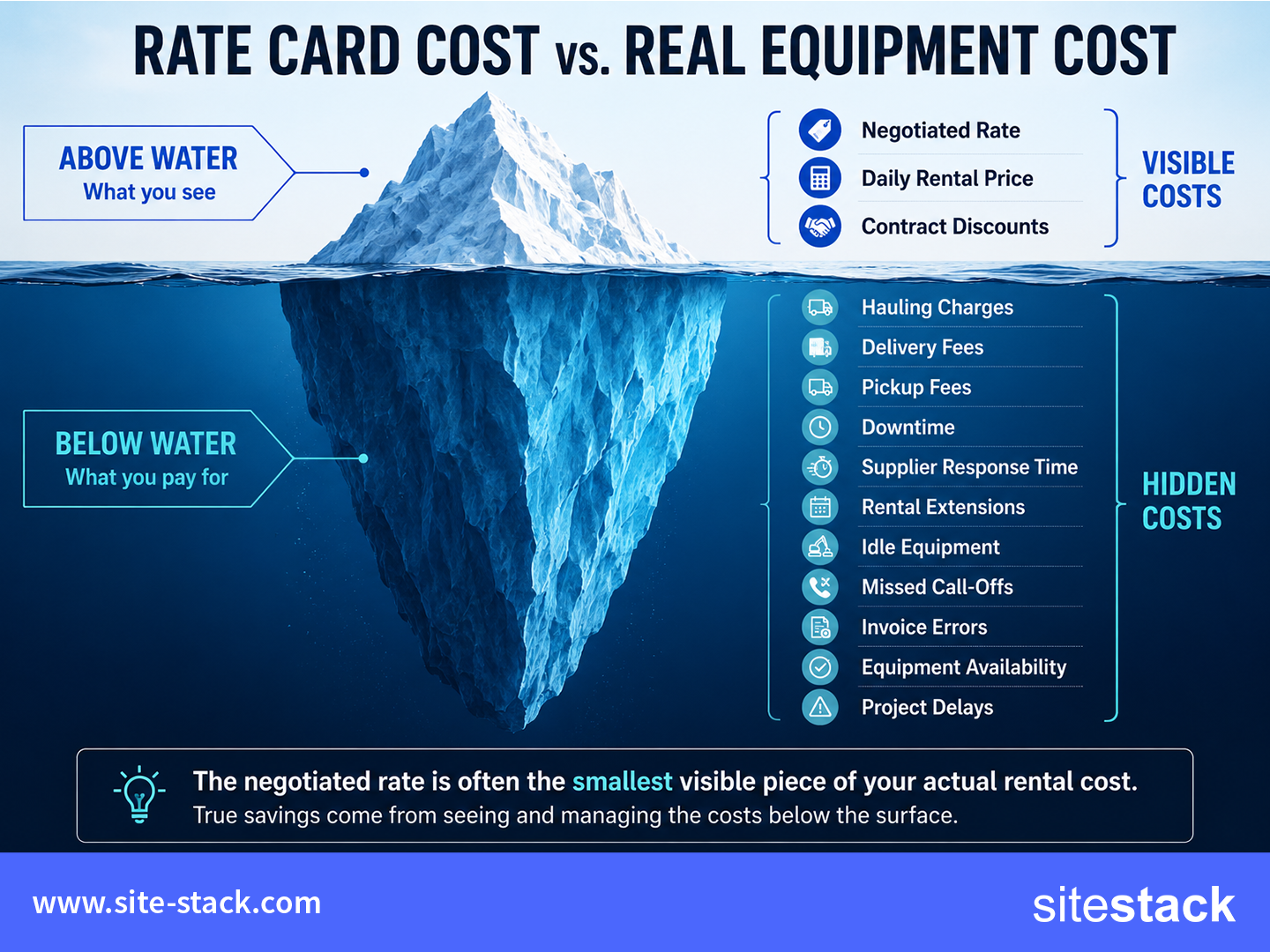
The Lowest Rate Is Not Always the Lowest Cost
Consider two suppliers providing the same piece of equipment:
Supplier A offers a daily rate that is 10% lower than Supplier B. At first glance, Supplier A appears to be the obvious choice. However, Supplier A's nearest branch is 75 miles away, requires three days of lead time, and charges substantially higher hauling fees.
Supplier B is located close to the project, can deliver the same day, and has lower transportation costs.
Although Supplier B's rate is higher, the total cost to the project may be significantly lower.
This is a scenario that plays out every day across the construction industry. Contractors negotiate aggressively on rates while overlooking the operational factors that ultimately determine spend. The result is that procurement decisions are sometimes optimized for contract pricing rather than project economics.
Most Rental Overspend Happens After the Equipment Arrives
Another reason negotiated rates can be misleading is that much of the waste associated with rentals occurs after procurement has already taken place.
Equipment that remains on rent longer than necessary generates costs regardless of how favorable the rate was. A machine sitting idle on a project for three weeks can erase months of procurement savings. Delayed pickups, missed call-offs, duplicate rentals across projects, and poor utilization often create far more financial impact than a small difference in daily pricing.
For example, saving 10% on a rental rate may reduce costs by a few hundred dollars over the life of a rental. Keeping that same machine on rent for an additional month because no one realized it was no longer needed can create thousands of dollars in avoidable spend.
The operational decisions surrounding a rental frequently matter more than the original procurement decision itself.
Procurement Needs Total Cost Visibility
The most effective construction organizations have started moving beyond rate-card management and toward total cost management.
Instead of asking whether they negotiated the best rate, they ask:
- What was the total delivered cost?
- How much did hauling contribute?
- Was the equipment fully utilized?
- How long did it remain on rent?
- Were call-offs completed on time?
- Did supplier proximity impact project performance?
- Would another supplier have produced a better outcome?
These questions provide a much more accurate picture of equipment spend because they evaluate the full rental lifecycle rather than a single pricing metric.
This is where true construction procurement intelligence begins to emerge. The objective is no longer simply securing discounts. The objective is understanding the factors that actually drive cost across the life of a rental.
The Future of Equipment Procurement Is Total Cost Optimization
Construction companies have become increasingly sophisticated in how they manage labor, schedules, and project performance. Equipment procurement is undergoing a similar evolution.
The organizations creating the largest savings are not necessarily those with the most aggressive negotiated rates. They are the organizations with the greatest visibility into utilization, logistics, supplier performance, and rental lifecycle management.
They understand that a rate card is only one input into a much larger decision.
The goal is not to achieve the lowest rate.
The goal is to achieve the lowest total cost.
Why SiteStack Focuses on What Happens Beyond the Rate Card
SiteStack was built around the idea that equipment procurement should be evaluated through the lens of total project cost, not just contracted pricing.
The platform helps contractors understand the variables that rate cards cannot capture, including supplier proximity, hauling costs, equipment availability, utilization, rental duration, call-off execution, and invoice validation. By connecting these factors into a single view, contractors gain a more complete understanding of what equipment actually costs and where opportunities for savings exist.
Because in construction, the negotiated rate is only the starting point.
The real equipment cost is everything that happens after the rental begins.