
Why Equipment Rental Invoices Are So Hard to Validate
Construction companies are under increasing pressure to improve equipment visibility, reduce downtime, optimize utilization, and control rental spend. As a result, many organizations are evaluating procurement and logistics software that promise to centralize equipment operations, procurement workflows, and asset visibility into one system.
On the surface, this sounds compelling.
In reality, procurement intelligence and fleet intelligence are two fundamentally different practices requiring different systems, different data models, and different operational workflows.
The challenge is that many “hybrid” platforms attempt to sit in the middle — without solving either problem deeply enough to become truly strategic software for an enterprise contractor.
Procurement and Fleet Management Are Not the Same
One of the biggest misconceptions in construction technology is the assumption that tracking equipment and making procurement decisions are naturally the same function.
They are not.
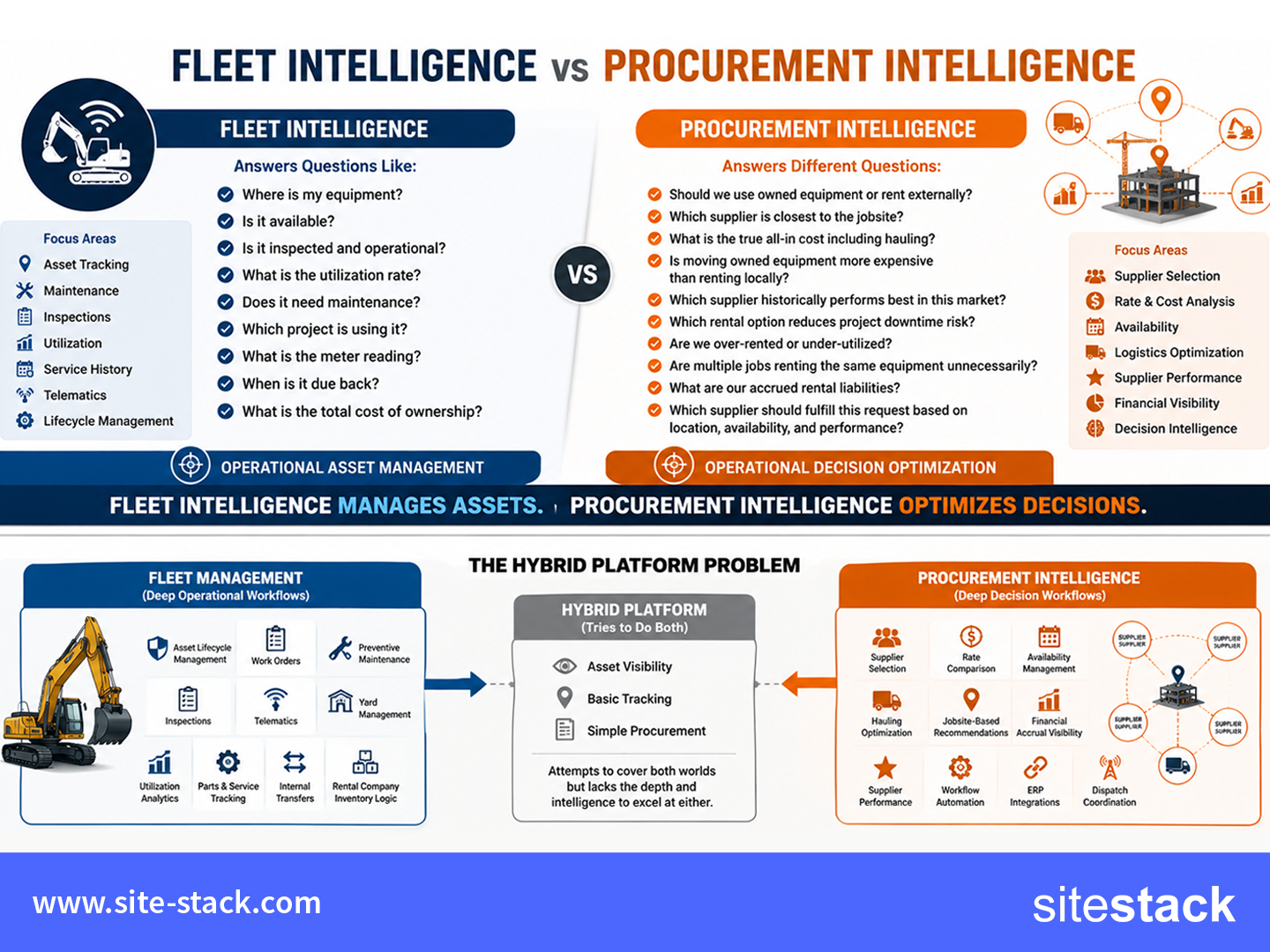
Fleet Intelligence Answers Questions Like:
- Where is my equipment?
- Is it available?
- Is it inspected and operational?
- What is the utilization rate?
- Does it need maintenance?
- Which project is using it?
- What is the meter reading?
- When is it due back?
- What is the total cost of ownership?
Fleet management systems are operational systems of record. They are designed to manage owned assets, maintenance workflows, inspections, assignments, service history, telematics, and utilization.
These platforms often operate like lightweight rental company software because that is effectively what large contractors become internally when they manage large, owned fleets.
Procurement Intelligence Answers Different Questions:
- Should we use owned equipment or rent externally?
- Which supplier is closest to the jobsite?
- What is the true all-in cost including hauling?
- Is moving owned equipment more expensive than renting locally?
- Which supplier historically performs best in this market?
- Which rental option reduces project downtime risk?
- Are we over-rented or under-utilized?
- Are multiple jobs renting the same equipment unnecessarily?
- What are our accrued rental liabilities?
- Which supplier should fulfill this request based on location, availability, and performance?
Procurement platforms are decision engines. They optimize supplier selection, rental execution, logistics, financial visibility, and operational efficiency across a fragmented vendor ecosystem.
These are not the same workflows.
Why Hybrid Platforms Often Struggle
Many newer construction technology platforms attempt to combine fleet visibility with procurement workflows into a single lightweight experience.
The problem is that enterprise construction operations are far more complex than simply tracking where assets are located or collecting rental quotes by email.
Once organizations mature operationally, hybrid systems often struggle because they lack the depth required to fully support either side of the equation.
To Compete as a True Fleet Platform, Software Must Support:
- Owned asset lifecycle management
- Work orders
- Preventive maintenance
- Inspection workflows
- QR and barcode systems
- Yard management
- Utilization analytics
- Telematics integrations
- Mechanic workflows
- Parts and service tracking
- Internal transfers
- Rental-company-style inventory logic
That is an enormous software category by itself.
To Compete as a True Procurement Platform, Software Must Support:
- Multi-supplier procurement
- Rate normalization
- Availability management
- Hauling optimization
- Jobsite-based supplier recommendations
- Financial accrual visibility
- Supplier performance analytics
- Workflow automation
- Enterprise approvals
- ERP integrations
- Supplier portals
- Dispatch coordination
- Real-time procurement intelligence
That is another massive software category.
Trying to lightly solve both often creates a platform that provides visibility but lacks meaningful operational intelligence.
Visibility Alone Is Not Optimization
Many construction companies already have some level of visibility today.
Large rental suppliers provide customer portals. Telematics providers offer fleet tracking. Fleet management platforms track owned assets. ERP systems contain financial records.
The challenge is not simply visibility.
The challenge is operational decision-making.
Knowing where equipment is located does not automatically determine:
- Whether it should remain there
- Whether it should be transferred
- Whether renting locally is cheaper
- Whether a supplier alternative would improve uptime
- Whether duplicate rentals exist across projects
- Whether owned equipment is economically justified
Construction companies do not improve margins simply because they can see assets on a map.
They improve margins when they make better operational and procurement decisions.
Why SiteStack Was Built Differently
SiteStack was not built to become another fleet tracking platform.
It was built to solve the procurement and operational intelligence problem that exists across construction organizations managing:
- Multiple suppliers
- Multiple jobsites
- Owned equipment
- Rented equipment
- Fragmented procurement workflows
- Complex logistics
- Large hauling costs
- Limited operational visibility
- Accrual uncertainty
- Supplier fragmentation
SiteStack approaches equipment procurement through the lens of logistics, supplier intelligence, and operational optimization.
The platform helps contractors determine:
- When to use owned equipment
- When to move owned equipment
- When to rent externally
- Which supplier creates the lowest all-in cost
- Which supplier is operationally best positioned for the jobsite
- Which rentals should be off rented
- Which projects are over-utilizing or under-utilizing equipment
- How supplier performance impacts execution
This is fundamentally different from simply tracking assets.
Enterprise Construction Requires Enterprise Decisioning
As contractors scale, the equipment challenge becomes less about asset visibility and more about operational coordination across projects, suppliers, logistics, and financial controls.
Large contractors eventually realize they need:
- A true fleet management strategy for owned assets
- A true procurement intelligence strategy for external rentals and operational optimization
These are complementary systems — not interchangeable ones.
The future of construction operations will not be built around lightweight hybrid tools attempting to partially solve both.
It will be built around platforms that deeply understand the operational complexity of construction procurement, logistics, supplier coordination, and enterprise decision-making.
That is the problem SiteStack was designed to solve.
Click here to learn more about SiteStack.